
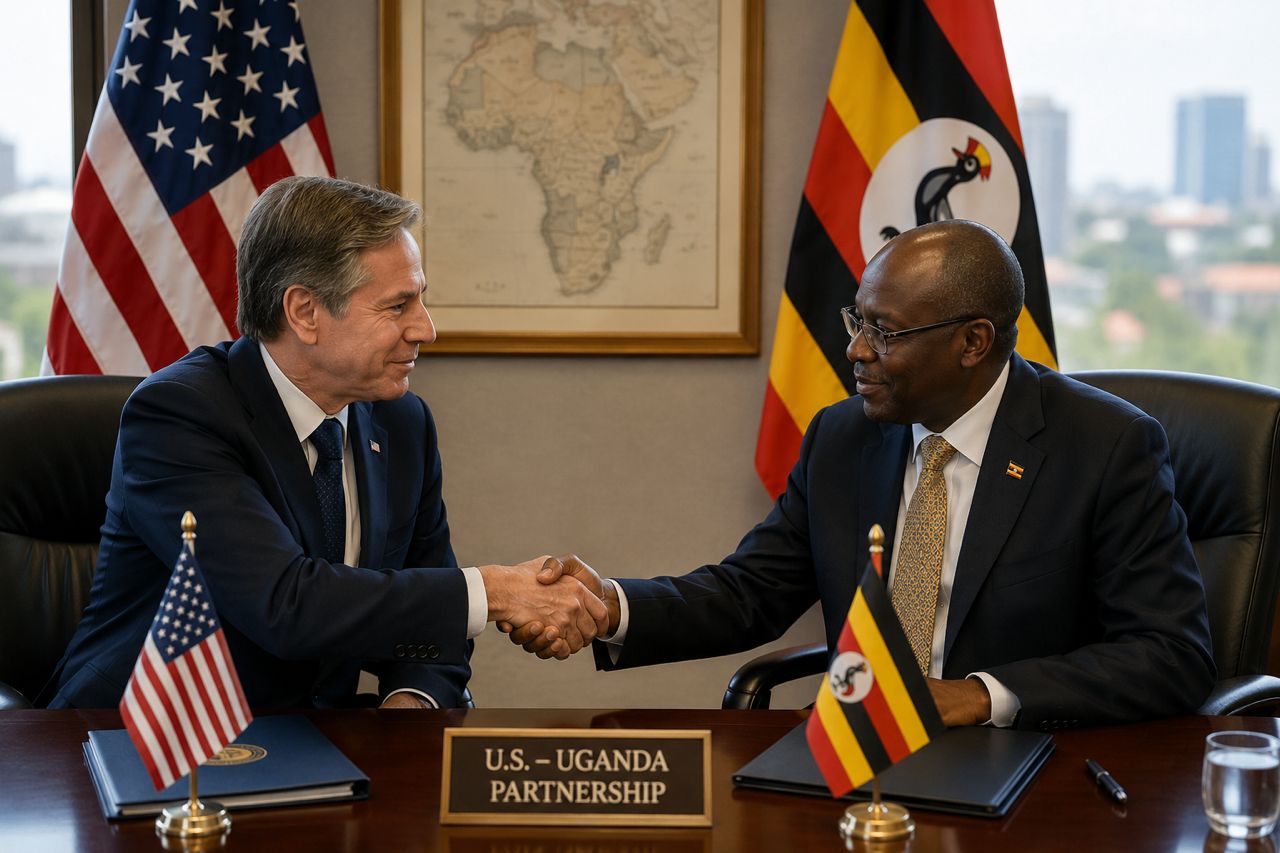
They Cannot Stop
MULINGIRIZI.COM · ANALYSIS
THEY CANNOT STOP
Why the US may continue funding Uganda despite calls to act otherwise: the strategic humanitarian loop
Every few years, someone in Washington announces that the United States has had enough of Uganda. A bill is tabled. A diplomat is summoned. Aid is suspended. Condemnations are issued. And then, quietly, methodically, with barely a change in the bureaucratic rhythm, the money keeps moving. The planes keep landing at Entebbe. The soldiers keep training in Jinja. The health workers keep counting antiretroviral doses funded by American taxpayers. The relationship, against all apparent pressure, holds.
This is not hypocrisy. It is not oversight. It is not even, exactly, cynicism — at least not in the vulgar sense. It is something more architecturally interesting: a self-reinforcing loop in which humanitarian investment and strategic interest have been so thoroughly interwoven that cutting one means cutting the other. Washington has built a relationship with Kampala that it functionally cannot abandon, no matter what Kampala does, because abandoning it would cost America more than it would cost Uganda.
This article dissects that loop. Not to exonerate Kampala’s government for the conduct that draws American criticism. Not to accuse Washington of operating in bad faith, but to open the black box of a relationship that is routinely debated in emotional or ideological terms, and rarely examined as the strategic mechanism that it actually is.
Washington has built something in Uganda that looks like a gift but functions like an investment, and you do not walk away from an investment because you are angry.
What the Loop Is — and Why It Forms
A strategic humanitarian loop is a foreign-policy configuration in which aid flows simultaneously serve two distinct masters: the language of human welfare and the logic of geopolitical interest. The loop becomes self-reinforcing when these two functions are so structurally embedded that disrupting either one threatens the other. It is not that Washington says one thing and does another. It is that Washington has designed a relationship in which saying and doing have become inseparable.
The loop in Uganda has three nodes, and they are worth naming clearly.
The first node is security. Uganda deploys the Uganda People’s Defense Forces (UPDF) through the African Union Mission in Somalia (AMISOM) and its successor ATMIS, which provides Washington with a capable, credible, politically acceptable proxy for counterterrorism operations in Somalia that America cannot conduct unilaterally without triggering the domestic and diplomatic costs of another African military intervention. AFRICOM was established in 2007, the same year AMISOM was authorized. That alignment was not accidental.
The second node is health. PEPFAR, the President’s Emergency Plan for AIDS Relief, has been operational in Uganda since 2004. It has restructured the country’s HIV/AIDS architecture at an institutional level: training health workers, funding supply chains, embedding American implementing partners inside Ugandan government systems. By 2024, Uganda accounted for one of the largest PEPFAR country envelopes on the continent. A sudden withdrawal would not merely reduce treatment access. It would collapse an infrastructure that the Ugandan state has not been resourced to replace.
The third node is institutional dependency. Thirty years of American aid have shaped the administrative culture of the Ugandan state: its procurement systems, its military officer training pathways, its civil-society architecture, its development bureaucracy. This is not a conspiracy — it is what sustained engagement produces. The Ugandan state, at the functional level, has been partially constituted by American assistance. Walking away from that would mean walking away from the architecture one built.
Three decades of American investment in Uganda have not merely transferred resources. They have transferred institutional DNA — and you cannot withdraw DNA without consequences to the organism that carries it.
The Somalia Variable: Why Kampala Is Structurally Indispensable
To understand why the loop is so resistant to rupture, begin where American strategists begin: Somalia. The collapse of the Somali state and the rise of al-Shabaab created a persistent terrorist sanctuary at the intersection of American strategic concerns — the Horn of Africa, the Red Sea shipping corridor, and East African maritime security. Washington needed a solution that did not involve another direct American military commitment in Muslim-majority territory so soon after Iraq and Afghanistan.
Uganda provided that solution. The UPDF is not a conscript force performing reluctant peacekeeping. It is a battle-hardened military with genuine counterinsurgency experience — forged in the LRA conflict, tested in the DRC, and progressively professionalized through years of American training investment. When Uganda committed troops to AMISOM, it was offering Washington something genuinely scarce: African military capability that could absorb ground combat in Mogadishu without triggering American domestic political costs.
The significance of this cannot be overstated. In 2011, when UPDF troops helped push al-Shabaab out of Mogadishu, American officials did not publicly celebrate, but the strategic relief was unmistakable. Uganda had done what Washington needed done, in a place Washington could not go, at a cost Washington was willing to pay indirectly through aid, training, and diplomatic protection.
THE NUMBERS
At peak deployment, Uganda committed over 6,000 UPDF troops to AMISOM — the largest single national contingent. American training support through ACOTA (Africa Contingency Operations Training and Assistance) has funded Ugandan peacekeeping preparation since the early 2000s. The U.S. has also provided logistical airlift, intelligence sharing, and consistent UN Security Council diplomacy supporting the mission’s mandate.
This is the Somalia variable: as long as al-Shabaab remains a going concern, as long as the ATMIS transition to Somali self-security remains incomplete, and as long as no other African military can credibly replace Uganda’s contribution, Washington has a structural reason to keep Kampala inside the tent, regardless of what happens outside it. The Anti-Homosexuality Act, the suppression of opposition political figures, the questions about electoral integrity: these are real, and American officials say so loudly. But they are, from the perspective of the security node, externalities. They do not affect the load-bearing function Uganda performs.
Al-Shabaab has, inadvertently, become one of Uganda’s most reliable protections against American aid withdrawal. The worse the security situation in Somalia, the more indispensable Kampala becomes to Washington.
The PEPFAR Paradox: When Humanitarian Investment Becomes Strategic Liability
PEPFAR is the most visible humanitarian node in the loop — and, paradoxically, the one that most clearly illustrates why Washington cannot simply pull the plug when it is angry with Kampala. By every measurable indicator, PEPFAR has been among the most successful American foreign-assistance programmes in history. In Uganda specifically, HIV prevalence among adults has fallen from double-digit percentages in the early 1990s to under 5% by the mid-2020s. The lives saved are not an abstraction.
But PEPFAR has also created a structural dependency that operates in both directions. Uganda depends on PEPFAR funding for a health infrastructure it cannot currently sustain domestically. America depends on PEPFAR’s Uganda results to justify the programme’s existence to Congress, to validate the model of development assistance, and to maintain the domestic coalition — evangelical Christians, global health advocates, public-health researchers — that has kept PEPFAR politically viable across four administrations of both parties.
When the Anti-Homosexuality Act passed in 2023, Washington faced precisely this paradox in real time. The Biden administration suspended some aid streams, deferred Millennium Challenge Corporation compacts, and issued strong condemnations. What it did not do was touch PEPFAR. The reason given was humanitarian: withdrawing treatment from HIV-positive Ugandans who had nothing to do with the legislation would be a moral catastrophe. That is true. But it is also true that withdrawing PEPFAR would have destroyed one of Washington’s most powerful arguments for the value of American engagement in Africa at a moment of intensifying competition with China. The humanitarian argument and the strategic argument pointed in the same direction. The loop held.
PEPFAR is simultaneously America’s most genuine gift to Uganda and America’s most effective argument against its own withdrawal. Washington has funded itself into a position it cannot exit without cost to its own credibility.
The Conditionality Theatre: Loud Enough to Satisfy, Quiet Enough to Preserve
If the loop is so robust, why does Washington make so much noise about Ugandan conduct? Why the press conferences, the suspended visas, the strongly-worded State Department statements?
The answer is that conditionality theatre serves the loop rather than threatening it. By performing outrage loudly, Washington satisfies the domestic constituencies, human-rights organizations, LGBTQ+ advocacy groups, progressive legislators, whose support it needs to maintain the broader aid programme politically. By calibrating the actual consequences carefully through suspending symbolic aid streams, deferring non-essential programmes, leaving the security and health nodes intact, Washington signals its displeasure without destabilizing the relationship.
This is not a secret strategy. It is the ordinary practice of mature alliance management, and both sides understand it as such. Kampala knows that Washington’s public statements are partly for domestic consumption. Washington knows that Kampala knows. The relationship continues because its structural logic is stronger than any single political event.
The pattern becomes visible across time. During the Northern Uganda conflict, when documented atrocities by both the LRA and Ugandan government forces were generating significant international attention, American counterterrorism cooperation with the UPDF deepened rather than contracted — because the LRA was designated a terrorist organization and Uganda’s military utility was at a premium. During the 2021 election period, when opposition figure Bobi Wine (Robert Kyagulanyi) was arrested and his supporters faced violent suppression, American condemnation was vigorous, yet AMISOM contributions were unaffected, and PEPFAR disbursements continued. The conditionality was applied where it could be applied without touching the load bearing nodes.
PATTERN TO WATCH
Conditionality in the US–Uganda relationship follows a consistent logic: maximum volume on issues that do not affect the security or health nodes (political repression, LGBTQ+ rights, press freedom); minimum disruption to programming that touches AMISOM/ATMIS readiness, PEPFAR delivery, or institutional capacity programmes embedded in Ugandan government systems. The clearest illustration came in 2023: when the Anti-Homosexuality Act passed, Washington suspended Millennium Challenge Corporation compacts and restricted some bilateral aid streams — visible, politically legible actions aimed at domestic American audiences. PEPFAR disbursements and UPDF cooperation under ATMIS continued without interruption. The conditionality was real. Its architecture was surgical.
American conditionality in Uganda is real, but it is calibrated. Washington shouts about what it can afford to shout about, and stays quiet about what it cannot afford to touch.
The China Variable: How Beijing Tightened the Loop
The loop was already robust before China’s expanding African presence. Beijing’s infrastructure investment across the continent, like the Standard Gauge Railway corridors, the port investments, and the telecommunications penetration, has added a new structural argument for maintaining American engagement in Uganda that did not exist a decade ago.
Uganda sits at a geopolitically significant node: landlocked, bordered by the DRC to the west (with its mineral wealth and ongoing instability), South Sudan to the north (with its oil and its fragility), and Kenya and Tanzania to the east and south (with their port access and economic weight). Rwanda’s position to the southwest adds a further dimension, a small but strategically agile state with its own complex American relationship and a demonstrated capacity to play Western and Eastern partners against each other with precision.
The Albertine Graben oil fields, straddling the Uganda-DRC border, have drawn sustained Chinese investment. The East African Crude Oil Pipeline (EACOP), running from Hoima to the Tanzanian port of Tanga, is a project of continental energy significance, and its financing structure reflects exactly the kind of Chinese-Western competition for infrastructure influence that Washington’s Africa strategists track closely.
In this context, reducing American engagement in Uganda does not produce a neutral outcome, but it produces a Chinese opportunity. Washington’s strategic planners understand this. Every dollar withdrawn from American aid programming in Uganda is, in the current competitive environment, a potential opening for a Beijing that is actively positioning itself as an alternative partner for African states that feel lectured or abandoned by the West.
The China variable has therefore functioned to tighten the loop rather than loosen it. Uganda’s leverage with Washington has quietly increased as the Great Power competition for African alignment has intensified, even though Kampala has not necessarily made that argument explicitly. The structural pressure does the work.
Uganda does not need to play the China card openly. The mere existence of the card, and Washington’s awareness of it, does the work in every negotiation, spoken or unspoken.
What This Means for Uganda — and for Africa
There is a version of this analysis that concludes with a celebration: Uganda has successfully navigated a complex relationship with a superpower and extracted maximum benefit while retaining sovereignty. That reading is not wrong, but it is incomplete.
The loop also has costs for Uganda. Structural dependency on PEPFAR has crowded out the development of domestic health financing. Security partnership with AFRICOM has, at times, reinforced the political centrality of the UPDF in ways that complicate civilian oversight. The institutional DNA transferred through decades of American assistance carries assumptions about governance, development, and civil society that are not always indigenous in origin or interest. Uganda has gained leverage, but it has also incurred a form of structural debt that is harder to see than a budget line.
For the broader African argument, the loop illuminates something important about the nature of the contemporary aid relationship. The question is no longer simply whether foreign assistance serves donor interests, since it obviously does. The question is whether African states are engaging with that reality with sufficient strategic intentionality. Uganda has stumbled into a version of strategic reciprocity — its AMISOM contribution has given it leverage it did not fully plan for. But leverage that is not deliberately cultivated and consciously deployed is leverage that will eventually erode.
The East African Community, IGAD, and the African Union have not yet developed a collective framework for engaging with the strategic humanitarian loop as a regional phenomenon rather than a series of bilateral relationships. That is the gap. When the AHA controversy erupted in 2023, the African Union’s institutional response was muted, member states absorbed Western pressure individually, each calculating its own exposure, none coordinating a regional position. The contrast with how ECOWAS managed the Sahel coup contagion, or how the AU mediated the Tigray ceasefire, is instructive: African institutions can act with collective weight when they choose to. On the aid-leverage question, they have not yet chosen. Individual states bargaining individually with Washington will always be at a structural disadvantage relative to a coordinated African position that can offer or withhold regional cooperation as a bloc.
Africa does not lack leverage in its relationships with the West. It lacks the institutional architecture to coordinate that leverage and so exercises it accidentally, bilaterally, and below its potential.
Conclusion: The Loop Does Not Break — It Bends
The strategic humanitarian loop binding the United States and Uganda is not fragile. It has survived the AHA, it has survived electoral violence, it has survived years of public condemnation and periodic aid suspensions. It will likely survive the next rupture, and the one after that. Not because Washington has no principles, but because the architecture of the relationship has made those principles more expensive to enforce than to perform.
This is the black box, opened: a relationship in which genuine humanitarian investment has been so thoroughly braided with strategic interest that the two are now structurally indivisible. Pulling one thread pulls the other. Cutting the knot harms the cutter as much as the cut.
The lesson for Uganda and for African states navigating similar relationships with Washington, London, or Brussels is not to exploit this dynamic irresponsibly. It is to understand it clearly. The loop is a structural reality, not a moral permission. It explains why the money keeps coming. It does not explain what to do with it, and that remains the harder question, and the more important one.
They cannot stop. But that does not mean Uganda should stop thinking about what happens when, one day, they do.
Understanding the loop is not an act of cynicism. It is an act of sovereignty.
ABOUT THE AUTHOR
Joshua Mulingirizi is a Preacher, Scholar, and Public Intellectual writing at the intersection of Biblical Truth and global affairs from Kampala, Uganda. joshua@mulingirizi.com
© 2026 Joshua Mulingirizi. mulingirizi.com