
The Case of Your Life: A Biblical Courtroom and How to Win
THE CASE OF YOUR LIFE: A Biblical Courtroom and How to Win
By Joshua Mulingirizi
I remember walking into a prayer venue once. The place was packed. The atmosphere was electric with spiritual aggression, voices raised, fists in the air, declarations flying like artillery. It looked, felt, and sounded like war. And in a very real sense, it was just as Revelation 12:7-8 tells us:
“And there was war in heaven: Michael and his angels fought against the dragon; and the dragon fought and his angels, and prevailed not.” (Revelation 12:7-8, KJV)
The dragon was not theorizing. He was fighting. And he was badly defeated, cast out, stripped of his heavenly position, hurled to the earth with his angels. The warriors I met were simply replicating the war in heaven, fighting the devil, and they were right, so right, given that there is a combative dimension to spiritual life. The adversary is real. The fight is real. The aggression has its place.
But here is where it gets theologically precise — and practically critical.
Overpowering the devil in combat is not the end of the matter. It is the beginning. Because a defeated enemy does not simply disappear. He files. Revelation 12:10 tells us what he did immediately after his military defeat:
“And I heard a loud voice saying in heaven, Now is come salvation, and strength, and the kingdom of our God, and the power of his Christ: for the accuser of our brethren is cast down, which accused them before our God day and night.” (Revelation 12:10, KJV)
He lost the war. He won a courtroom seat. Cast to the earth, he exchanged his sword for a legal brief and opened a new front entirely, the courtroom of human experience. The warrior became the prosecutor. And the rules of engagement changed completely.
You can overpower the devil through prayer, fasting, and spiritual warfare, and you must. But overpowering him only issues him a summons to the courtroom. And in that courtroom, volume means nothing. Aggression means nothing. What matters is constitutional precision, the kind Jesus demonstrated in the wilderness.
Consider it carefully. Jesus had just fasted forty days. He was spiritually empowered, charged with the Holy Spirit, primed for confrontation. He could have rebuked the devil with fire. He had the raw spiritual authority to simply overpower him.
But when the adversary came, Jesus did not shout. He did not perform. He opened the Constitution.
“It is written.”
Three times the accuser filed a charge. Three times, Jesus cited a statute. Not with emotion but with precision. The devil tempted Him to turn stones to bread, and He answered, “It is written, Man shall not live by bread alone.” The devil tempted Him with a spectacular display, “Cast thyself down,” even citing Scripture himself, attempting to use the Constitution against its Author. Jesus rebutted with a higher statute: “It is written again, Thou shalt not tempt the Lord thy God.” The devil offered Him the kingdoms of the world, but Jesus dismissed the offer with finality: “It is written, Thou shalt worship the Lord thy God, and him only shalt thou serve.”
Three prosecutorial motions. Three statute citations. Case dismissed.
Notice what Jesus never did. He never raised His voice. He never complained about the injustice of being tempted while hungry. He argued. Precisely. Legally. From the written record.
This is the model. Warfare empowers you to show up. Knowledge of the Constitution empowers you to win. You need both, but you cannot stop at the former. The prayer house that only knows how to fight and never learns to argue will win battles and lose cases. The believer who masters the Word becomes not just a warrior but a constitutional lawyer, and that combination is what the adversary cannot withstand.
Because the courtroom is where the real verdicts are issued. And in that courtroom, only one thing silences the accuser:
“It is written.”
The Courtroom Is Already Assembled
Scripture does not merely suggest a judicial framework. It constructs one — with every office, every role, every procedural element of a functioning court of law.
God is the Judge. Not an angry tyrant, not an indifferent spectator but the Righteous Judge before whom every case is heard and every verdict is final. “God is the judge: he putteth down one, and setteth up another.” (Psalm 75:7, KJV) He does not rule on emotion. He is bound by His own law, not because He is cold, but because law is what makes justice possible. A judge who rules on feeling is not merciful. He is corrupt. Isaiah 1:18 reveals His character on the bench with disarming clarity: “Come now, and let us reason together, saith the LORD: though your sins be as scarlet, they shall be as white as snow.” (KJV). This is a Judge who invites the argument. He does not shut down the proceedings. He opens them.
Satan is the Accuser — the Plaintiff. His Hebrew title, ha-satan, literally means the adversary , opposing counsel. He does not appear in Scripture raging but reasoning. In the book of Job, he comes to the heavenly court not with a sword but with a carefully constructed legal argument: Job’s faithfulness is circumstantial. Remove the blessings, he contends, and the loyalty collapses. This is not a demon throwing tantrums. This is a prosecutor building a case in a methodical, strategic, and legally precise manner. He knows what you did. He knows what was done to you. He knows what you have neglected. He knows the Law, and in fact, he uses it against you with greater precision than most believers have ever read it. Do not romanticize your adversary. Revelation 12:10 says he accuses you day and night — no off days, no fatigue, no mercy, no intention of dropping the charges.
Zechariah 3 gives us a courtroom scene of striking precision. Joshua, the high priest, stands before the Angel of the Lord. Satan stands on his right hand, the position of the prosecuting attorney in the legal custom of the ancient Near East. The evidence against the defendant is damning: Joshua is clothed in filthy garments. Exhibit A is on the table. The prosecution’s case is legally sound. Satan was not lying. He was prosecuting accurately. But watch what happens: “And the LORD said unto Satan, The LORD rebuke thee, O Satan; even the LORD that hath chosen Jerusalem rebuke thee: is not this a brand plucked out of the fire?” (Zechariah 3:2, KJV) God did not argue about the filthy garments. He did not deny the evidence. He overruled the prosecution based on a higher legal instrument, which is election and mercy, a principle that outranks the accusation being leveled. Then immediately: “Take away the filthy garments from him. And unto him he said, Behold, I have caused thine iniquity to pass from thee, and I will clothe thee with change of raiment.” (Zechariah 3:4, KJV) The prosecution’s evidence was removed by divine order. New garments, representing justification, were placed on Joshua. The verdict was acquittal. Not because Joshua argued brilliantly. But because his Advocate had legal grounds to move for dismissal on a higher principle.
Jesus Christ is our Advocate. 1 John 2:1 states it with legal economy: “And if any man sin, we have an advocate with the Father, Jesus Christ the righteous.” (KJV) The word translated advocate is the Greek parakletos, the one called alongside to defend. He does not argue your innocence. He presents His own righteousness as your substitution. And here a critical clarification must be made because a dangerous misunderstanding lurks in the shadows of this truth.
A Necessary Clarification: The Blood Is Your Entry, Not Your Argument
There is a school of prayer that reduces every spiritual transaction to one phrase: “I plead the blood of Jesus.” And while the blood of Jesus is the most powerful legal instrument in the history of the universe, pleading it without constitutional knowledge is like a licensed attorney arriving at court with his bar certification and no prepared brief. He has the right to be there. He has nothing to say when he gets there.
Hebrews 10:19 is precise on this point: “Having therefore, brethren, boldness to enter into the holiest by the blood of Jesus.” (KJV) The blood gives you boldness to enter. It does not give you the argument once you are inside. It opens the courtroom door. The Word of God is what wins the case behind that door.
Think of it this way. Justification — your right standing before God — is entirely the work of Christ’s blood. No amount of biblical knowledge earned your acquittal. The cross accomplished that without your assistance. But the daily enforcement of that verdict in the theatre of your lived experience requires that you know what has been written, cite what has been promised, and argue from what has been established.
Romans 8:33-34 captures both dimensions in a single passage: “Who shall lay any thing to the charge of God’s elect? It is God that justifieth. Who is he that condemneth? It is Christ that died, yea rather, that is risen again, who is even at the right hand of God, who also maketh intercession for us.” (KJV) The justification is settled, and God Himself secured it. But notice that Christ at the right hand of the Father is making intercession actively, presently, continuously arguing your case. He is not resting on the completed work of the cross as though the proceedings are over. He is engaged. He is arguing. And He expects His co-defendants to be equally engaged with the Constitution that governs their freedom.
The blood is your credential. The Word is your brief. The Spirit is your counsel. Remove any one of these and your legal representation is incomplete.
A believer who only pleads the blood without knowing the Word will walk into court with access but no argument. A believer who knows the Word but neglects the blood has argument but no standing. A believer who has both but ignores the Spirit has knowledge but no interpretation for the specific contours of their specific case.
All three are non-negotiable. All three are active. And all three are available to every defendant who takes their case seriously enough to prepare.
The Holy Spirit is the Legal Advisor and the Interpreter of the Law. He, too, is called parakletos in John 14:26 — your in-house counsel, the one who sits beside you in the courtroom and intercedes with precision where your vocabulary fails. Romans 8:26 states it plainly: “Likewise the Spirit also helpeth our infirmities: for we know not what we should pray for as we ought: but the Spirit itself maketh intercession for us with groanings which cannot be uttered.” (KJV) We do not always know the correct legal language. We do not always know which precedent applies to our specific situation. But the Spirit does. He is not simply a comforter in the emotional sense, but He is a legal advisor in the most precise sense, the one who takes the Constitution you have studied and shows you exactly which statute applies to the case currently before the bench.
You are the Defendant. Not the judge. Not the prosecutor. The defendant, which means your role is not to run the proceedings. Your role is to know your case, trust your Advocate, and master the Constitution. The courtroom is not a metaphor. It is the operating system of the spiritual universe.
The Magna Carta of Spiritual Success
The Lord, knowing precisely what Lucifer is and what Lucifer is not, gave us a sobering Magna Carta, a foundational charter for the success of life. It is found in Joshua 1:8:
“This book of the law shall not depart out of thy mouth; but thou shalt meditate therein day and night, that thou mayest observe to do according to all that is written therein: for then thou shalt make thy way prosperous, and then thou shalt have good success.” (Joshua 1:8, KJV)
Break this down legally. “Shall not depart out of thy mouth” means your legal citation must be on your lips, ready for use. A lawyer who cannot cite the statute in the courtroom has failed his client, regardless of how much they studied at home. “Meditate therein day and night” is the Hebrew word hagah, which means to murmur, to mutter, to rehearse under your breath repeatedly. This is legal preparation. A barrister preparing for a major case does not read the relevant legislation once. They rehearse it, turn it over, find every angle, anticipate every counter-argument. “Observe to do according to all that is written” — this is compliance with precedent. In law, you cannot cite a statute in your defense if you are simultaneously in violation of it. Your life must be aligned with the law you are citing. This is why personal holiness is not optional in spiritual warfare, but rather it is a legal standing. “Then thou shalt make thy way prosperous, and then thou shalt have good success” — these are legal outcomes. Prosperity and success in this context are not lottery winnings. They are the verdict of a court that found for the defendant because the defendant came prepared, cited the law correctly, and lived in alignment with it.
Joshua 1:8 is not a devotional suggestion. It is pre-trial legal counsel from the Judge Himself.
And the church has largely slandered it, dismissed it as optional, replaced it with emotional worship experiences, substituted feelings for statute, and then wondered why we keep losing cases we should have won. Hosea 4:6 is God’s most direct judicial warning on this matter: “My people are destroyed for lack of knowledge: because thou hast rejected knowledge, I will also reject thee.” (KJV) Destroyed — a legal term describing the outcome of a case lost. Lack of knowledge — the reason for the loss. Not a lack of sincerity. Not lack of passion. Not lack of worship attendance. Lack of knowledge of the law. And the most painful phrase: “because thou hast rejected knowledge.” This is not ignorance through unavailability. This is ignorance through choice and the deliberate preference for emotional experience over legal preparation. God’s response is judicial: your representation will be deemed inadequate. Your case will be dismissed against you because you came to court uninformed and unprepared.
Ignorance of the law has never exonerated anyone in any court — civil, criminal, or spiritual. The adversary does not pause his prosecution because you do not know your rights. He advances precisely because you do not. Your silence in the courtroom is not humility. It is a forfeiture.
The Law of Precedent
Every mature legal system operates on precedent — the doctrine that past rulings establish the binding standard for present cases. The Bible is the greatest body of legal precedent ever assembled. Whatever you face today, someone in Scripture faced before you. God ruled on it. That ruling stands. It can be cited. It must be cited.
When you stand before the Judge and cite what He has already ruled, you are not begging. You are enforcing. You are not asking Him to do something new. You are reminding the court of what is already written and demanding that the adversary comply with the existing order.
Consider what happens when guilt becomes the prosecution’s primary exhibit. David sinned catastrophically — adultery, murder, cover-up. The adversary’s case was airtight. But David did not simply weep and withdraw. He filed a formal petition in Psalm 51, arguing from the Judge’s own established character: “Have mercy upon me, O God, according to thy lovingkindness: according unto the multitude of thy tender mercies blot out my transgressions.” (Psalm 51:1, KJV) He appealed to the Judge’s own record — His mercy, His steadfast love, as the legal basis for restoration. The Judge ruled in his favor. David returned to purpose. The precedent is established: guilt does not permanently disqualify where genuine repentance invokes the mercy of the court. Cite it — 1 John 1:9: “If we confess our sins, he is faithful and just to forgive us our sins, and to cleanse us from all unrighteousness.” (KJV)
When the prosecution argues biological impossibility — that what you are believing for cannot happen, that the medical report is final, that the season has passed, the Shunammite woman of 2 Kings 4 is your precedent. Barren, her husband old, Elisha spoke the word of the Lord over her: she would hold a son. She did. The son later died. And she did not accept the verdict of death. She saddled a donkey and rode to the man of God. When asked, “Is it well with the child?” she answered: “It is well”, even before the miracle. She argued from faith, not from circumstance. She enforced the original ruling of life spoken over her household. The adversary had attempted to overturn the ruling. She refused the amended verdict. The child was restored. The precedent stands: what God has declared over your life cannot be permanently overturned by circumstance. Cite Isaiah 54:1: “Sing, O barren, thou that didst not bear; break forth into singing, and cry aloud.” (KJV)
When the prosecution deploys conspiracy, witchcraft, workplace betrayal, or organised spiritual attack — Isaiah 54:17 is settled statutory law: “No weapon that is formed against thee shall prosper; and every tongue that shall rise against thee in judgment thou shalt condemn. This is the heritage of the servants of the LORD.” (KJV) Note the legal language: heritage. This is not a privilege to be earned. It is an inheritance to be enforced. Every tongue that rises against you in judgment — conspiracies, curses, coordinated attacks — you have statutory authority to condemn. Numbers 23:23 further establishes: “Surely there is no enchantment against Jacob, neither is there any divination against Israel.” (KJV) Witchcraft and spiritual manipulation filed against a child of God have no legal standing in this court. The adversary’s case is inadmissible. File the counter-motion. Issue the restraining order of Luke 10:19: “Behold, I give unto you power to tread on serpents and scorpions, and over all the power of the enemy: and nothing shall by any means hurt you.” (KJV)
And when the prosecution presents financial ruin as a final verdict, Job is your most powerful precedent. Stripped of everything by the most aggressive prosecution in the biblical record, Job’s defense was imperfect. He wavered. He questioned. He nearly broke. But he never cursed God, and Job 42:10 records the ruling: “And the LORD turned the captivity of Job, when he prayed for his friends: also the LORD gave Job twice as much as he had before.” (KJV) Double restitution. Proverbs 6:31 establishes this as a legal principle: when the thief is found, he shall restore sevenfold. The adversary who stole your health, your finances, your relationships, your years, a verdict in your favor does not merely return what was stolen. It orders the thief to repay many times over. Cite Joel 2:25: “And I will restore to you the years that the locust hath eaten.” (KJV)
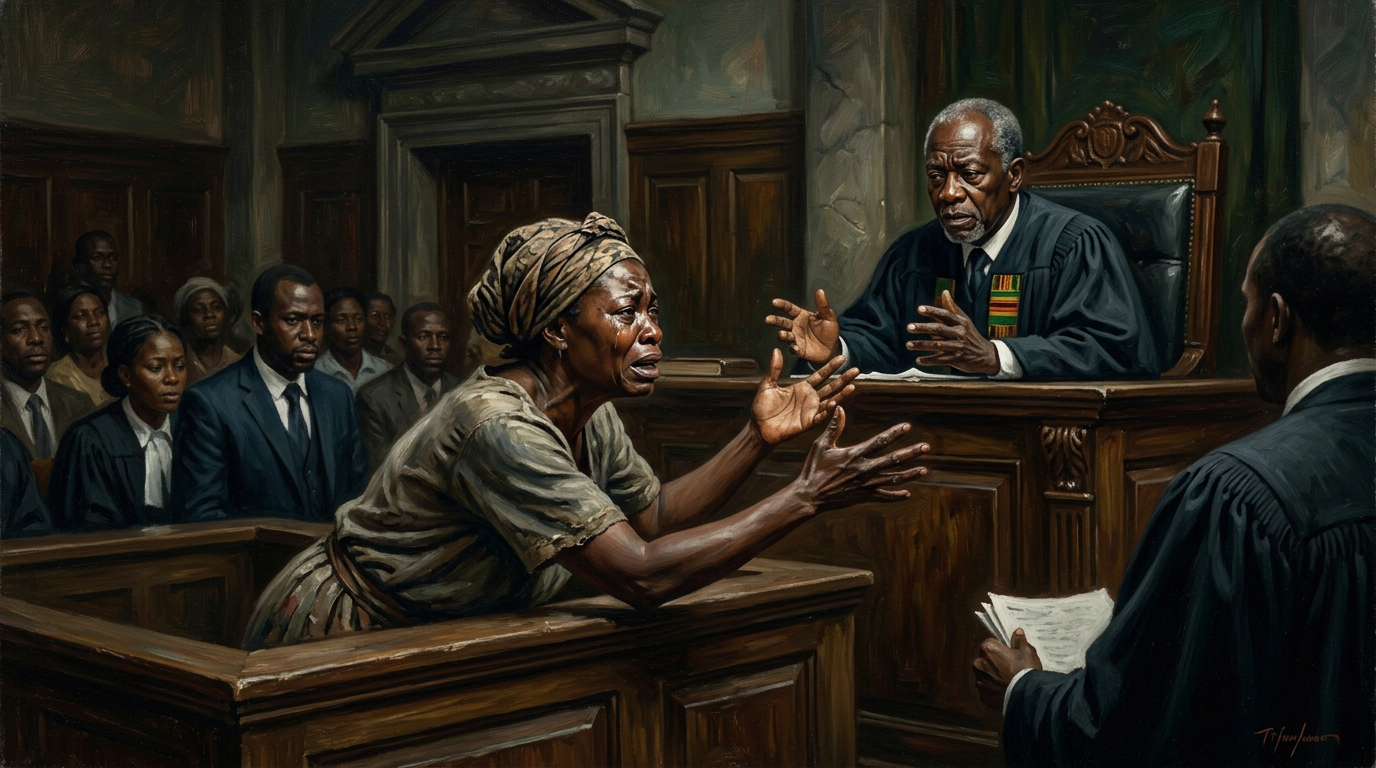
Stop Crying in Court
When you enter a courtroom and begin to wail, the judge may feel pity. But pity does not change the verdict. He is bound by the Constitution, not by the volume of your tears. If you cry for an hour and cite no statute, you leave the courtroom precisely as you entered it, except now the adversary has had more time to build his case while you performed your grief.
Imagine yourself in that courtroom. The prosecutor has just spent forty minutes citing relevant statutes, presenting documented evidence, referencing case law, and precedent. He sits down. The judge looks at you and says, “Your response?” And you stand up and begin to cry. You tell the judge how hard your life has been. You describe how unfair the charges are. You list everything you have lost. The judge, who genuinely has compassion for you, cannot return a verdict based on your tears. His court has a procedure. His bench has precedent. His judgments are bound by law, not because he is cold, but because law is what makes justice possible.
“For the LORD your God is God of gods, and Lord of lords, a great God, a mighty, and a terrible, which regardeth not persons, nor taketh reward.” (Deuteronomy 10:17, KJV) “Regardeth not persons” — God is not swayed by your vulnerability, your poverty, or your pain when rendering legal verdicts. He is the most impartial judge who ever presided.
Some of us have had unanswered prayers for years because we have been making noise before the Judge rather than making arguments. We have been presenting our emotions rather than our evidence. We have been in contempt of the very court that exists to vindicate us.
There is a place for tears. Jesus wept. The Psalms are saturated with lament. But a lament that does not transition into a legal argument is an incomplete filing. Weep if you must, and then open the Constitution. Cite the case law. Remind the court of what is written. And issue the adversary a restraining order backed by Scripture.
“Study to shew thyself approved unto God, a workman that needeth not to be ashamed, rightly dividing the word of truth.” (2 Timothy 2:15, KJV) “Rightly dividing”. A lawyer who misquotes a statute, who cites the wrong precedent, or who misapplies the law loses the case regardless of the merit of their client’s position. God is calling you to be a competent legal representative of your own case.
The Verdict Is Already Entered. Now Enforce It.
Romans 8:1 declares it without qualification: “There is therefore now no condemnation to them which are in Christ Jesus.” (KJV) The Accuser can file. He can present exhibits. He can argue through the night. But he cannot overturn a ruling sealed by the blood of the Advocate.
Your role is not to win the war. Christ won the war. Your role is to enforce the verdict with the calm, precise, legally grounded confidence of one who knows what is written. The divine court does not merely acquit. It compensates. When the defendant wins, the false prosecutor is ordered to restore. Job received double. The thief is required to restore sevenfold. The years the locust ate are returned in full. A verdict in your favor is not merely freedom from the charge. It is a restoration of everything the prosecution cost you.
So go home. Open the Constitution. Find your precedent. Cite your statutes. Trust your Advocate. Cooperate with your Legal Advisor. And stand before the bench with the calm, precise confidence of one who knows that the Judge has already ruled and that the ruling cannot be overturned.
Not with noise. Not with panic. But with the legally grounded precision of one who has studied, who knows what is written, and who understands that “every tongue that shall rise against thee in judgment thou shalt condemn.” (Isaiah 54:17, KJV)
Not God doing it for a passive, weeping, unprepared believer.
You, armed with the law, represented by the Advocate, counseled by the Spirit, will condemn every tongue that rises against you in judgment.
That is your heritage. Now prepare your case.
“This book of the law shall not depart out of thy mouth; but thou shalt meditate therein day and night, that thou mayest observe to do according to all that is written therein: for then thou shalt make thy way prosperous, and then thou shalt have good success.” — Joshua 1:8, KJV
Joshua Mulingirizi is a Preacher, Scholar, and Public Intellectual writing at the Intersection of Biblical Truth and global affairs from Kampala, Uganda.
This is nice
Thank you, Solome
I’ve loved the script. So spiritual and power packed. Hope you gonna share more. Thanks
Thanks Pastor